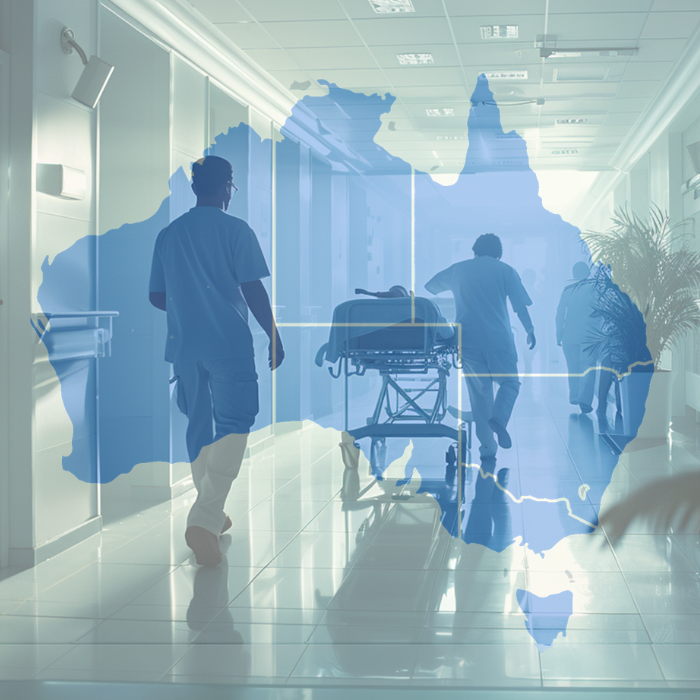
When someone has a stroke, timing becomes critical. For every minute treatment is delayed, 1.9 million neurons die (1). In Australia, where a third of the population lives outside major cities, that minute can turn into hours, not because specialist care doesn’t exist, but because it’s too far away.
One in four Australians will have a stroke in their lifetime. In 2024, someone had a stroke every eleven minutes. By 2050, the interval is expected to shorten to one every ten minutes, with new cases rising from around 60,800 a year in 2020 to over 132,500 a year by 2050. The population most exposed to this growth, rural and remote Australians, already face a 19 per cent higher incidence of stroke than the national average, and stroke tends to strike Indigenous Australians at least ten years earlier, with mortality rates three to five times higher than for non-Indigenous Australians (1).
The Queensland Telestroke Service
Queensland carries more than its share of this burden. The state accounts for nearly 20 per cent of stroke cases nationwide, with more than 9,000 Queenslanders having a stroke each year and almost 89,000 stroke survivors living across the state, many with ongoing disability (2). Queensland Health notes that regional Australians are 17 per cent more likely to experience a stroke than people in metropolitan areas (3). A stroke specialist cannot be everywhere a patient needs one.
The Queensland Telestroke Service (QTS) was established to close that gap. Backed by a $5.8 million government investment and based at the Royal Brisbane and Women’s Hospital, QTS works with Queensland’s four Comprehensive Stroke Centres to bring specialist stroke assessment across regional and remote communities (2).
The story is bigger than rural access alone. Queensland needed to connect hospitals without onsite neurology to 24/7 specialist expertise, make imaging immediately available across enormous distances, standardise previously fragmented referral pathways and determine which patients genuinely required urgent transfer.
Connecting the clinical pathway with the imaging platform
A telestroke service is only as effective as the imaging workflow that supports it. Even when specialist review is available by video, neurologists must be able to access high-quality imaging instantly and collaborate in real time with local clinicians and, where required, interventional neuroradiologists. Critical decisions should be made from a shared view of the patient’s imaging, not delayed by phone calls, disconnected systems or fragmented PACS workflows. While QTS provides one clinical pathway, Nicolab provides the connected imaging and decision-support environment across the state.
The broader Nicolab deployment at Queensland Health covers up to 44 hospitals across the state, with 38 hospitals currently live. Nicolab’s StrokeViewer analyses imaging in the cloud as soon as a scan is acquired, making the results available simultaneously to the local clinical team, neurologist and interventional specialists. Rather than information moving sequentially between teams, everyone works from the same imaging dataset in real time. This enables hospitals without on-site neurology services to assess patients via telehealth and access specialist stroke expertise immediately, supporting faster and more informed treatment decisions.
The first results
The volume moving through that environment shows how embedded it has become in day-to-day practice. In 2025, more than 12,000 cases per week were sent to Nicolab’s StrokeViewer across Queensland. Of those, more than 25% of patients had an ischaemic stroke and almost 5% had a suspected haemorrhagic stroke, the two categories a clinician needs to tell apart within minutes to choose the right treatment path. At Gold Coast University Hospital, the time between a scan being uploaded and a clinician first viewing it in the Nicolab app averaged around ten minutes, a pace that turns a bottleneck that used to cost hours into a step that barely interrupts the clinical workflow.
Queensland’s experience shows what happens when a clinical pathway and a connected imaging platform are built together rather than bolted on afterwards. As an example, at Townsville University Hospital, there has been a sixfold increase in the number of regional patients treated, with faster, better-informed transfer decisions. Consistent, round the clock access to specialists regardless of postcode. As QTS continues its rollout through 2028, the same principle that has driven it so far holds: One pathway and stroke care that no longer depends on how far a patient lives from the coast.
Want to learn more?
Contact your Nicolab sales representative or reach out to us at info@nicolab.com.
About Nicolab
Nicolab was established in 2015 following the world-leading MR CLEAN clinical trial and operates as an Australian-based public unlisted company. A team of researchers, developers, and medical specialists drives its mission to advance healthcare through innovative, AI-driven solutions that improve patient care.
Its flagship solutions include StrokeViewer, which delivers AI-powered imaging insights and coordination for stroke care, and Nicolab Assist, which extends AI-powered imaging insights and coordination across acute care pathways to support a broader range of urgent clinical workflows.
Learn more www.nicolab.com
Sources
(1)Australian Stroke Alliance, Stroke Golden Hour: Building on our Success 2026-2031, Executive Summary, 2026.
(2)Queensland Health, “Every second counts: Telestroke transforming care across Queensland”, 26 August 2026. https://www.health.qld.gov.au/newsroom/news/every-second-counts-telestroke-transforming-care-across-queensland
(3)Stroke Foundation, 2021 report on regional stroke incidence, cited in Queensland Health, “Every second counts: Telestroke transforming care across Queensland”, 26 August 2026.